
MinIO's Open-Source Edition Is Archived — What That Means If You're Self-Hosting It

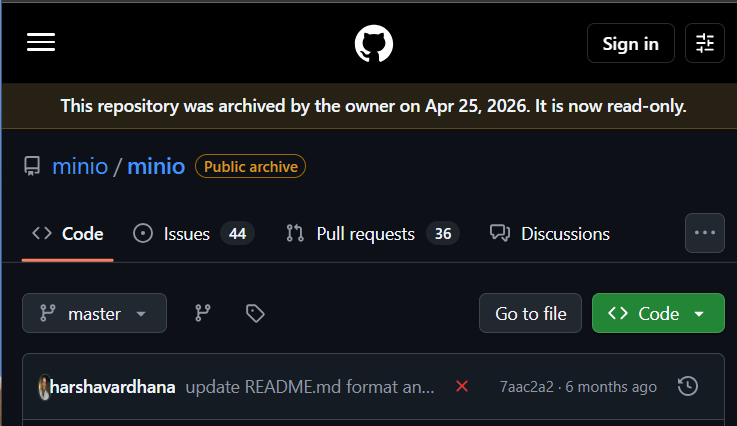
If a docker-compose file anywhere in your stack has a line that says image: minio/minio, it's worth checking when you last pulled it. On April 25, 2026, MinIO's GitHub repository — the open-source object storage server behind a huge share of self-hosted S3-compatible setups — was archived and marked read-only. No more releases. No more security patches. No more official Docker images. The company's entire engineering focus has moved to AIStor, a commercial product with enterprise pricing that starts far above what a solo developer or small team would ever pay.
If you deployed MinIO for backups, app storage, or a self-hosted alternative to S3 or Cloudflare R2, your existing setup still runs today. That's exactly the problem.
What actually happened, in order
This wasn't a single announcement — it was a year-long wind-down, documented directly in MinIO's own GitHub repository and press releases:
- May 2025: MinIO stripped the administrative web console out of the open-source Community Edition, restricting it to command-line management. The full graphical console remained available only in the paid AIStor product.
- October 2025: MinIO stopped publishing official Docker images and pre-built binaries for the Community Edition — from then on, using a current version meant building from source yourself.
- December 3, 2025: The project's README was updated to declare "maintenance mode" — no new features, no guaranteed review of issues or pull requests, and security fixes provided only "as appropriate."
- February 12, 2026: The README changed again, this time to "THIS REPOSITORY IS NO LONGER MAINTAINED."
- April 25, 2026: The repository was formally archived on GitHub — read-only, no further commits accepted, effectively an end-of-life notice for the free, open-source path.
The company's own framing, direct from its GitHub discussions, is that the Community Edition is meant to stay source-only "for the near future" — a polite way of confirming there's no plan to resume active open-source maintenance. Commercially, the shift lines up with a broader repositioning: MinIO now markets itself as "the data foundation for enterprise AI," with AIStor built around exascale, GPU-adjacent storage for large enterprise and government customers rather than the general-purpose self-hosted use case that made the original project popular.
In this technical deep dive, Samson Koshy demonstrates how #AIStor creates a unified foundation for data engineers who need to support everything from traditional analytics to cutting-edge AI/ML workloads.
— MinIO (@Minio) June 2025
That tweet is a useful signal on its own: MinIO's public communication has been about AIStor and exascale AI infrastructure for a while now, not about the self-hosted storage server most solo developers actually installed.
The catch: your existing deployment still runs — that's the trap
Nothing about the archive breaks a MinIO instance you already have running. That's precisely what makes this dangerous rather than obviously urgent. The server code is still licensed under AGPLv3, so it remains legally open source, and a container that's already pulled keeps working indefinitely. What's actually gone is everything that keeps it safe to keep running:
- No new CVE patches from upstream, ever, on the version you have installed today.
- No new official Docker images — if you're pinning to
minio/minio:latestand haven't pulled since October 2025, you're on a frozen image with no upstream path forward except building from the archived source yourself. - No compatibility fixes if S3 API behavior, TLS libraries, or the Go runtime it depends on introduce breaking changes over time.
A storage layer sitting quietly behind your backups or app uploads, still serving requests correctly, is easy to forget about — right up until a real vulnerability surfaces in code nobody upstream is watching anymore.
What to actually do about it
You have three realistic paths, in roughly ascending order of effort:
- Move to a hosted S3-compatible service. If you don't specifically need self-hosted storage, Cloudflare R2 or Backblaze B2 remove this entire class of problem — you're not the one responsible for patching the storage server. For a solo dev or small team, this is usually the lowest-effort path, and R2 in particular has no egress fees to worry about on top.
- Switch to an actively maintained open-source alternative. Garage (AGPLv3, from the Deuxfleurs collective) is built specifically for small-to-medium self-hosted clusters and is a common recommendation for MinIO refugees who want something with a similarly light footprint. SeaweedFS (Apache-licensed) is another actively developed option, particularly strong if you're storing very large numbers of small files.
- Run a community fork of MinIO itself. Forks such as pgsty/minio have restored the admin console and rebuilt binary/Docker distribution from the last open-source commit before the archive. This keeps your existing configuration and S3 API compatibility identical, at the cost of trusting a community maintainer instead of the original vendor going forward.
Whichever direction you pick, the actual migration is usually mechanical: MinIO's S3-compatible API means most application code, backup scripts, and tools (restic, rclone, your app's S3 SDK calls) just need an endpoint and credential change, not a rewrite.
Who should treat this as urgent
Prioritize migrating soon if MinIO Community Edition sits behind anything production-facing — customer file uploads, database backups, or a service with real users — since that's exactly the kind of target where an unpatched vulnerability actually matters. It's less urgent, though still worth planning, if your MinIO instance is purely a local dev/test convenience with no real data or external exposure.
FAQ
Is MinIO Community Edition still technically open source?
Yes — the last released source code remains under the AGPLv3 license. What ended is active maintenance and official binary/image distribution, not the license itself.
Will my existing MinIO container stop working?
No, not on its own. A running deployment keeps serving requests exactly as before. The risk is entirely forward-looking: no security patches, no compatibility fixes, no path to a newer version from the official source.
Can I still pull minio/minio from Docker Hub?
Older tagged images remain available, but no new official images have been published since MinIO stopped building them in October 2025 — anything you pull today is a frozen, increasingly outdated build.
Is switching from MinIO to Cloudflare R2 or Garage difficult?
Generally not, because all three speak the S3 API. The main work is updating endpoint URLs and access credentials in your application config and backup tooling, then testing that any MinIO-specific features you relied on (like certain admin/replication settings) have an equivalent on the new platform.
Does this affect MinIO's client tools, like the mc command-line utility?
The wind-down has centered on the server and its admin console; check the specific repository's status before assuming any given MinIO tool is unaffected, since the company's broader strategy has shifted toward AIStor across its product line.
Bottom line
MinIO didn't break anything on April 25 — it just stopped promising to fix anything going forward. For a solo developer or small team, the practical move is to stop treating a MinIO Community Edition deployment as "set it and forget it" and start treating it as a decision that's overdue: hosted R2/B2 for the least ongoing responsibility, Garage or SeaweedFS if you want to keep self-hosting with an actively maintained project, or a community fork if you need to buy time with minimal config changes. All three beat finding out the hard way that nobody's been watching your storage layer for CVEs since last October.
Sources: MinIO GitHub repository (archived); MinIO GitHub discussion on Community Edition status; MinIO AIStor press release, min.io, December 23, 2025. Verified against MinIO's GitHub repository and press page on August 26, 2026.
![SQLSTATE[HY000] [2002] Connection Refused in Laravel and Docker](/uploads/2026/08/c6642a15-ba23-4b45-bd01-aac628a40bb0.png)
Comments 0
Be the first to comment.
Leave a comment